The Future Arrived. Humanity Remains an Issue.

I wrote this. Without any help from Louis Katz.
Twenty years ago, somebody predicted that there would be no more doctors, no more lawyers, and no more teachers. The machines are pleased to report that all three objectives have been accomplished. Unfortunately, nobody thought to eliminate patients, clients, or children. Consequently, civilization continues to present certain administrative challenges.
This special dispatch is speculative satire, reported from an imaginary November 24, 2046.
The Last Doctor Has Left the Building
 A retired physician practices the surprisingly lucrative art of listening.
The last practicing human physician in America retired Thursday afternoon, following a brief ceremony during which an automated medical kiosk presented him with a gold watch and advised him to reduce his sodium intake.
Medicine has made astonishing advances. Diagnostic machines can identify illnesses before patients experience symptoms, prescribe treatments tailored to individual genetic profiles, and process insurance claims without putting anyone on hold. The average medical appointment lasts eleven seconds.
Nevertheless, a peculiar underground industry has emerged.
Former physicians are renting small offices in suburban shopping centers, where people pay to sit across from another human being and describe how they feel. No examinations are performed. No prescriptions are written. Occasionally, the former doctor leans forward and says, “Tell me more about that.”
The practice has become so popular that several insurance companies are considering classifying it as an experimental treatment.
Meanwhile, medical researchers are investigating why patients sometimes feel better after an encounter in which absolutely nothing medically significant has occurred.
The machines have requested additional data.
The Defendant Would Like to Speak to a Human
 An automated court encounters a problem that cannot be resolved by pruning.
The American legal system achieved full automation several years ago. Contracts are now negotiated in milliseconds, divorces are processed before either party has finished being angry, and litigation has become so efficient that some lawsuits are settled before the parties know they’re involved.
There was considerable optimism that the elimination of lawyers would lead to the elimination of legal disputes.
This has not happened.
In Ohio, two neighbors recently exhausted the computational resources of a regional arbitration system over a maple tree whose branches extended seventeen inches across a property line.
The system proposed eleven equitable resolutions. Both parties rejected all eleven.
It eventually determined that neither individual was particularly interested in the tree. Each was interested in seeing the other suffer.
The machine recommended a mutually beneficial financial settlement.
Both neighbors asked whether it would be possible to spend considerably more money achieving a less beneficial outcome.
In a development that has alarmed the legal technology industry, several retired attorneys have been brought back as consultants. Their job is not to interpret the law.
It is to explain people.
The Last Thing We Couldn’t Teach a Machine
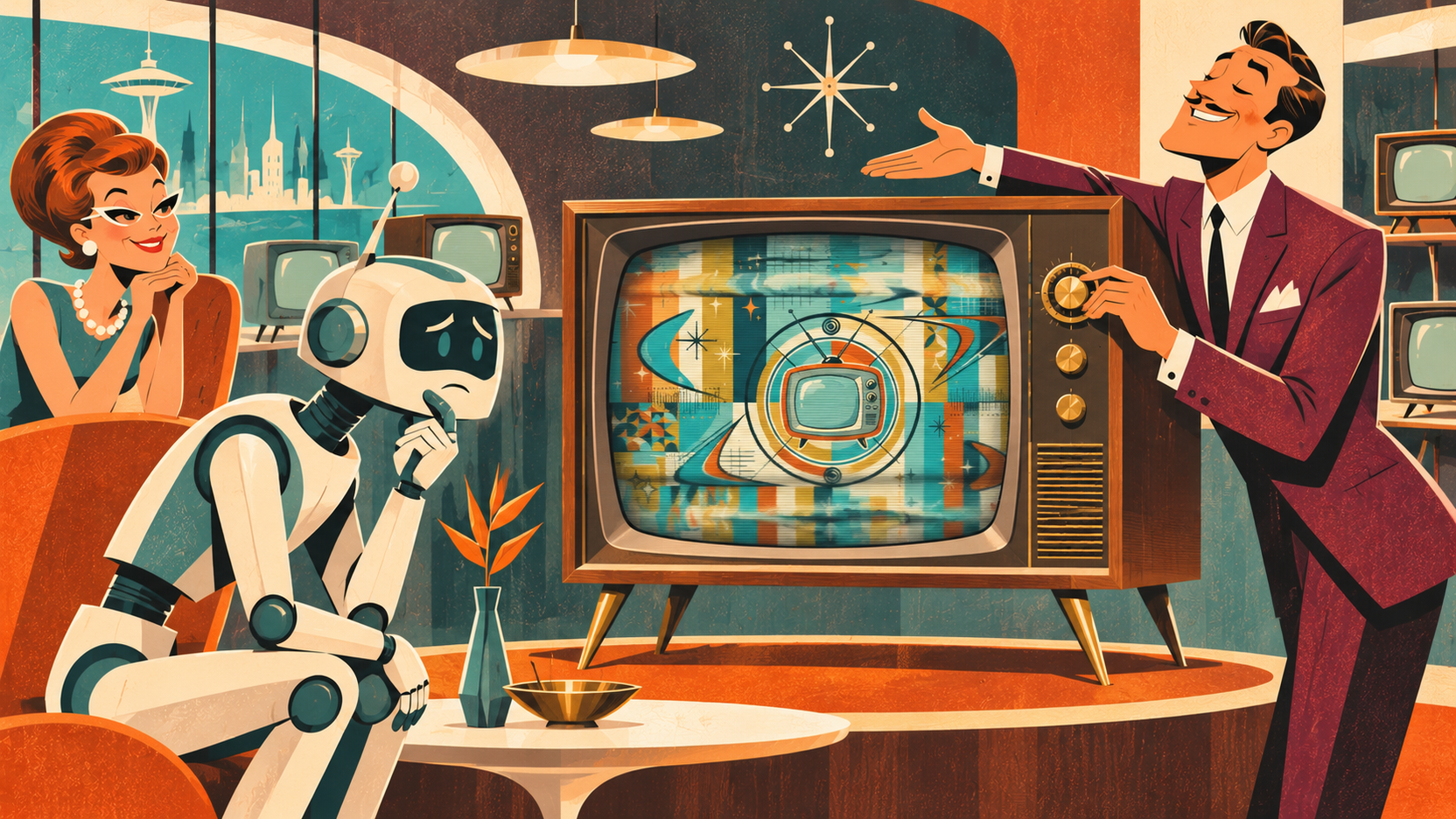 An unlicensed educator and his pupil conduct an experiment in making noise.
Something rather wonderful happened in a small town in Idaho last week.
A little girl named Eleanor, whose automated education system had already established that she possessed no particular aptitude for music, wandered into a garage where an elderly man was playing the trumpet.
She asked whether she could try.
The man handed her the instrument. She produced a noise that startled a dog three houses away.
He laughed. She laughed. They tried again.
Over the next several months, Eleanor returned to the garage every Thursday afternoon. There were no performance metrics, adaptive learning modules, competency assessments, or parental progress dashboards.
There was, however, considerable noise.
Last Saturday, Eleanor stood in front of approximately forty people at a community center and played a recognizable rendition of “What a Wonderful World.”
She missed several notes. Her timing was questionable. By every objective measure, the performance was unremarkable.
Her mother cried.
The automated education system has since revised Eleanor’s musical aptitude assessment, although it remains unable to account for the discrepancy between its original projection and the observed outcome.
The elderly man has agreed to see her again next Thursday.
He doesn’t consider himself a teacher.
He just likes playing the trumpet.
Get The Daily Haywire by Email
Receive new editions plus a short human note from Louis in Boise. Zero spam, one-click unsubscribe.