
Tuesday, October 27, 2026
Today is John Cleese’s 87th birthday. The man who gave us Basil Fawlty, the Ministry of Silly Walks, and the world’s most elaborately unhelpful argument clinic has spent much of his professional life demonstrating that human beings are perfectly capable of making simple things preposterously difficult.
Which makes him the ideal patron saint of modern technology.
Today’s installment concerns computers that won’t get out of our way, the peculiar indignity of not getting a job you didn’t particularly want, scientists who are making things invisible, a fungus with delusions of dinosaurhood, and the possibility that lightning has been quietly misbehaving for centuries.
Somewhere, Basil Fawlty is beating a server with a tree branch.
The Next Great Interface Is No Interface at All

I played with Apple’s new iPhone Duo yesterday, and I was impressed. That’s not something I say lightly about technology.
The fold is practically invisible. The engineering is astonishing. Apple has managed to make a flexible display feel like an ordinary screen, which is roughly the technological equivalent of inventing a folding dinner plate that doesn’t leak gravy.
But I came away admiring the engineering rather than the vision.
I’ve felt for years that Apple lost something fundamental when Steve Jobs died. Not its ability to make beautiful hardware. Not its attention to detail. Certainly not its ability to separate customers from substantial quantities of money.
It lost sight of one of Jobs’ most important ambitions: making the operating system disappear.
The original Macintosh made computers accessible to people who didn’t want to learn a command language. The iPhone took things further by letting us manipulate objects directly on a screen.
Yet here we are, decades later, still learning where somebody decided to hide a setting, which gesture makes a window disappear, and why three devices that know perfectly well who we are insist on asking us to identify ourselves again.
The next revolution isn’t going to be another screen, no matter how ingeniously it folds.
It’s going to be the elimination of the interface itself.
Consider what a gadget, a car, an airplane, and a wormhole have in common.
Each exists to overcome some obstacle between what we want and what we want to accomplish.
We don’t necessarily want to operate a computer. We want to communicate, create, or solve a problem.
We don’t necessarily want to drive a car. We want to go somewhere.
We don’t necessarily want to pilot an airplane. We want to be somewhere considerably farther away.
And if somebody ever figures out how to build a traversable wormhole, I sincerely hope it won’t require downloading an app, creating an account, and agreeing to receive promotional notifications before entering.
The common thread is the distance between intention and fulfillment.
For most of human history, technological progress has meant giving us better tools to bridge that distance. But those tools still demand that we learn how to operate them.
Imagine instead a world in which the machinery understood what we wanted and handled the details.
Artificial intelligence offers part of that possibility. Autonomous vehicles offer another. Neither is remotely finished, and both raise enormous questions about reliability, privacy, safety, and control.
The objective shouldn’t be to eliminate human choice. It should be to eliminate the unnecessary effort required to exercise it.
And let’s not confuse removing an interface with removing an experience. Driving a sports car, taking photographs, cooking dinner, and playing a musical instrument can be immensely pleasurable. Technology shouldn’t deny us those pleasures simply because it can automate them.
But when all we want is the result, why must we endure the procedure?
There’s a delightful absurdity in the fact that increasingly sophisticated computers still require ordinary people to become amateur systems administrators just to live their lives.
Jobs wanted the computer to get out of our way.
Somebody needs to finish the job.
Apple’s iPhone Duo announcement
I Didn’t Get the Job. Unfortunately, My Ego Found Out.

Back in April, I interviewed for a job at Starbucks.
I met Megan and Mike, had a perfectly pleasant experience, and came away with the impression that things had gone rather well.
I didn’t get the job.
In fact, I managed to collect two rejections in a single day.
This was disappointing, particularly because I’d developed serious reservations about the prospect of getting up even earlier than my dogs, who already consider four in the morning a perfectly reasonable time to begin discussing breakfast.
The rejection was therefore a curious mixture of relief and indignation.
On the one hand, I wouldn’t have to get up at an hour normally reserved for dairy farmers, commercial fishermen, and people fleeing the authorities.
On the other hand, somebody had apparently decided that I wasn’t suitable for a job I had already begun talking myself out of wanting.
My ego, naturally, demanded an investigation.
This is one of the peculiar things about looking for work after a long career running your own business. You spend decades solving other people’s problems, only to discover that your ability to solve those problems doesn’t necessarily translate into somebody else’s definition of the ideal employee.
And while I genuinely enjoyed meeting Megan, the process reminded me how much I’d come to value setting my own course.
There was, however, consolation in the form of Black Market Gelateria, an astonishingly good gelato establishment in an industrial part of town where you’re rather more likely to encounter truckers than tourists.
There is something wonderfully incongruous about finding exceptional gelato in a neighborhood that looks as though its principal commercial activity involves loading docks.
Which brings us to the latest development in my occupational misadventures.
Haha. I’m an IT guy again.
After 23 years running Technolene, selling the business, and pursuing other possibilities, I’ve launched ITPTSD.
I’m the IT guy for people who can’t stand IT guys.
It turns out that one of the things I know how to do particularly well is help people whose technology has decided not to cooperate.
And now I can do it without asking anyone’s permission to come to work.
Best of all, I can set my own hours.
The dogs, unfortunately, remain in charge of mornings.
Scientists Have Invented an Invisibility Cloak. There’s a Catch.
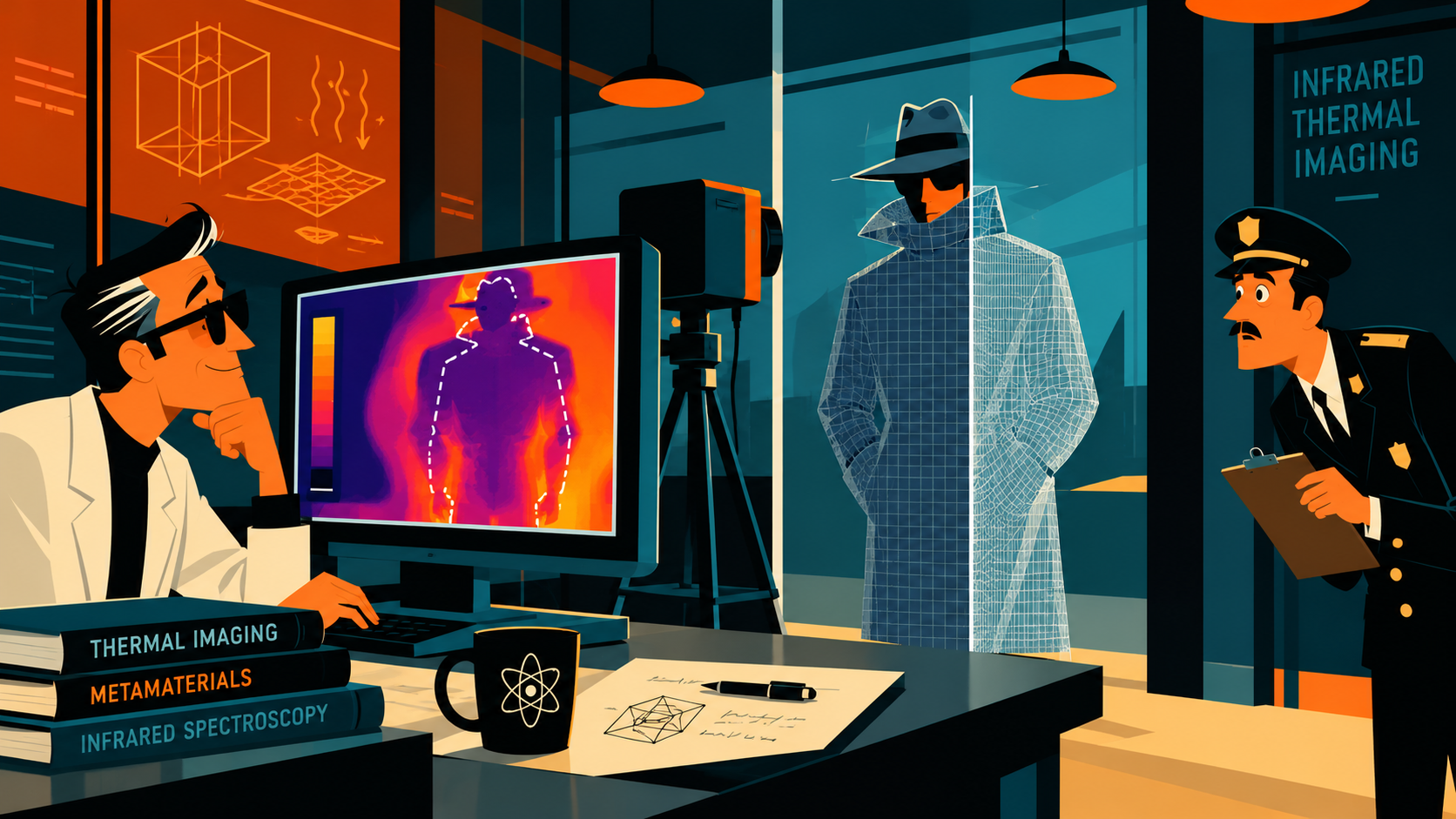
Researchers at the University of Illinois Urbana-Champaign have created a three-dimensional thermal invisibility cloak that can hide objects from infrared cameras.
Before you begin planning a career in international espionage, there’s a small qualification.
The cloak doesn’t make things invisible to the human eye. It makes them difficult to detect through thermal imaging.
Which is somewhat less exciting if you’ve always dreamed of sneaking into a cinema without buying a ticket, but potentially far more useful if you’re designing advanced electronics.
The researchers combined a 3D-printed aluminum lattice with a rubber-like material to redirect heat around concealed objects. Rather than merely insulating something, their structure preserves the surrounding temperature pattern so that an infrared camera effectively sees what looks like empty space.
They’ve demonstrated the approach with complicated three-dimensional shapes, overcoming important limitations of previous thermal cloaking experiments.
Possible applications include protecting sensitive electronic components from extreme temperatures, improving heat management, and reducing thermal detection.
This is serious engineering with potentially valuable applications.
But I keep imagining Basil Fawlty trying to explain to a hotel inspector why a guest has become invisible to the thermal camera but remains plainly visible standing in the dining room.
Perhaps the next breakthrough will be making the guest invisible to the bill.
Read the University of Illinois research
Meet D-Rex, the Fungus That Thinks It’s a Dinosaur

Scientists working in China’s Yunnan province have identified an extraordinary fungus called Dianjunus rex, affectionately nicknamed D-rex.
It can grow to approximately 20 inches tall and weigh nearly five pounds.
Five pounds of fungus.
For perspective, that’s considerably more fungus than anybody needs unless they’re catering a wedding for several hundred vegetarians.
The researchers found something even more remarkable when they examined its genetic history.
D-rex is so different from known fungi that scientists established an entirely new genus and family to accommodate it.
Its evolutionary lineage may date back roughly 65 million years, not long after the extinction of the non-avian dinosaurs.
One possibility is that the vast quantities of dead vegetation left by the ecological upheaval provided new opportunities for organisms capable of decomposing wood.
The researchers are also interested in why this particular fungus grows so large. One hypothesis is that its extraordinary height helps disperse spores above the surrounding vegetation.
In other words, it may have spent millions of years evolving the fungal equivalent of standing on a chair so everyone can hear it.
The discovery is a reminder that even after centuries of biological exploration, we’re still finding organisms that don’t fit neatly into our classifications.
And unlike the dinosaurs, D-rex has managed to survive without Steven Spielberg making a movie about it.
Yet.
Scientists May Have Put Ball Lightning in a Bottle
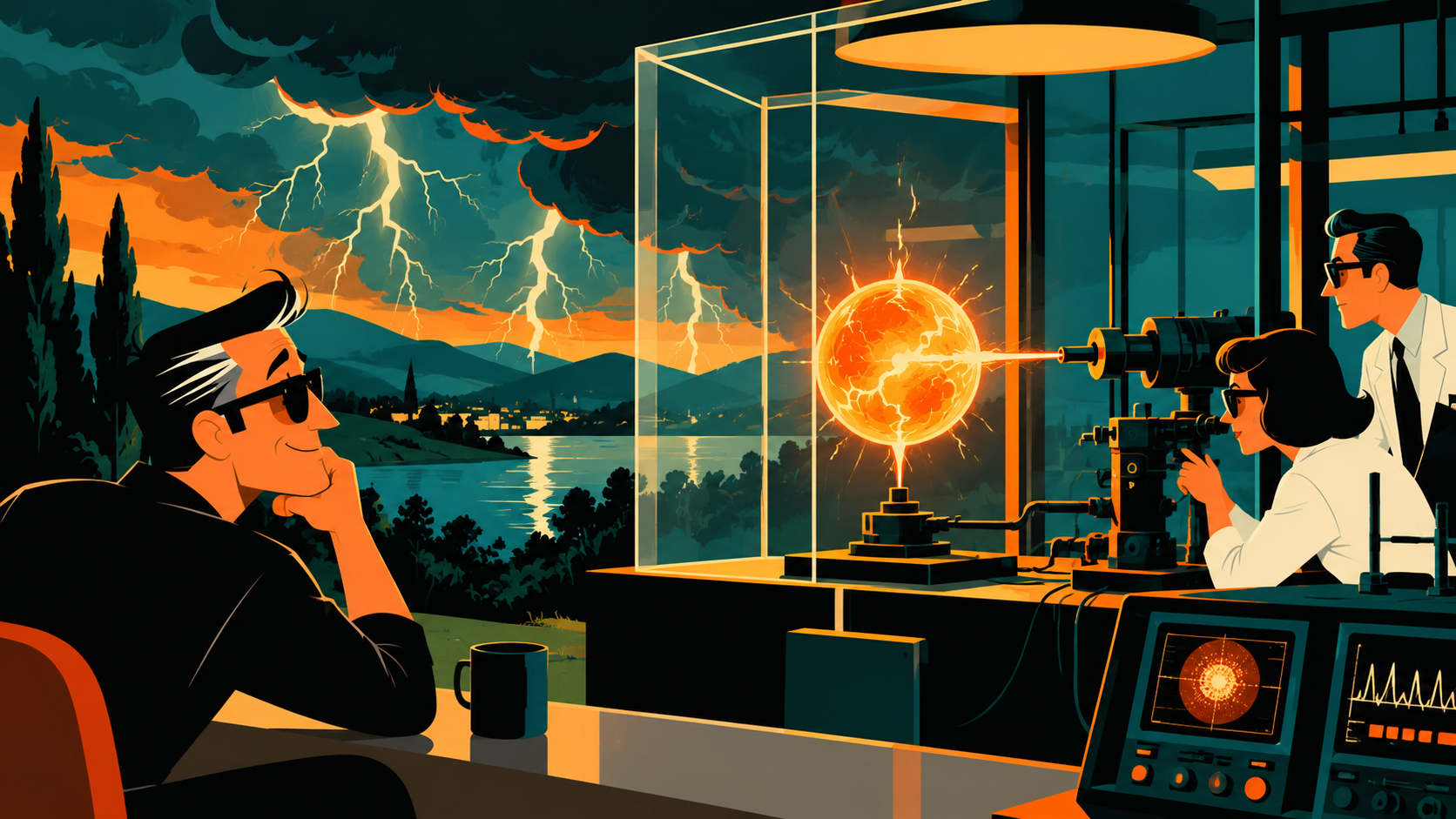
For centuries, people have reported seeing mysterious glowing spheres during thunderstorms.
Unlike ordinary lightning, which gets straight to the point and then disappears, so-called ball lightning has been described as floating, drifting, and occasionally vanishing with an audible pop.
Naturally, scientists have had a difficult time studying something that appears unpredictably, lasts briefly, and tends to occur during weather that sensible people avoid.
Researchers at the Chinese Academy of Sciences have now produced tiny luminous plasma spheres in laboratory conditions that may help explain the phenomenon.
Using an extremely fine tungsten needle, an ultrashort laser pulse, and argon gas, they generated a concentrated electromagnetic field that produced a glowing ball of plasma.
The sphere was microscopic and lasted only a tiny fraction of a second. Nevertheless, its behavior was consistent with a theoretical structure known as an electromagnetic soliton, in which interacting physical effects help maintain a wave’s form.
The researchers suggest that related mechanisms operating at larger scales might account for at least some reports of ball lightning.
That’s an intriguing possibility, not a definitive solution to the mystery.
But it gives scientists something repeatable to study rather than relying exclusively on reports from people who have just seen a luminous object float past their garden shed.
Personally, I find it reassuring that after mastering nuclear energy, landing machines on Mars, and putting enormously powerful computers into our pockets, we’re still not entirely sure what lightning is getting up to.
There may be hope for mystery yet.
Happy Birthday, John Cleese

John Cleese turns 87 today.
Few performers have been so consistently brilliant at exposing the absurdity of systems, institutions, and human behavior.
From the Ministry of Silly Walks to the customer-service nightmare of the argument clinic, his comedy often begins with a simple premise: What happens when somebody takes an inherently ridiculous arrangement completely seriously?
It’s a question worth asking whenever your computer informs you that you must authenticate your identity before you can change a setting intended to make authentication less inconvenient.
Perhaps the greatest tribute we could pay Cleese would be to design a world with fewer procedures that seem to have been invented by Monty Python.
Although that might put Monty Python out of business.
Codebreaker
Yesterday’s Answer: The Two Ropes
Yesterday’s challenge involved two ropes, each of which takes exactly one hour to burn completely, but not necessarily at a uniform rate. How do you measure 45 minutes?
Light the first rope at both ends and the second rope at one end.
The first rope will burn completely in 30 minutes, regardless of how unevenly it burns.
At that moment, light the other end of the second rope.
The second rope now has 30 minutes of burn time remaining, but with both ends burning, it will finish in 15 minutes.
Thirty plus fifteen equals 45.
For safety reasons, we recommend conducting this experiment entirely in your imagination.
Today’s Puzzle: The Counterfeit Coin
You have nine coins that look exactly alike.
Eight are genuine and weigh the same. One is counterfeit and weighs slightly less.
You have an old-fashioned balance scale, but you’re allowed to use it only twice.
How do you identify the counterfeit coin?
No batteries. No computers. No AI. Just your brain and two opportunities to tip the scales.
The answer tomorrow. Assuming our artificially intelligent editorial staff can figure it out.
